
Lorem ipsum dolor sit amet, consectetur adipiscing elit. Aliquam euismod est eu libero faucibus fringilla. Pellentesque habitant morbi tristique senectus et netus et malesuada fames ac turpis egestas. Quisque id erat lacus. Vestibulum ut lorem arcu. Integer a tortor eget arcu fringilla egestas eget in libero. Sed laoreet viverra molestie. Interdum et malesuada fames ac ante ipsum primis in faucibus.
Fusce volutpat tristique ex in malesuada. Donec luctus nunc et magna vulputate laoreet. Curabitur malesuada efficitur ipsum. Etiam vulputate mi sed elit fringilla consectetur. Donec arcu nulla, elementum vitae iaculis nec, mattis eget sapien.
“The Cavendish Women in Physics have made unparalleled contributions to the Cavendish Laboratory’s extraordinary history of discovery and innovation in Physics and continue to do so.”
Lorem ipsum dolor sit amet, consectetur adipiscing elit. Aliquam euismod est eu libero faucibus fringilla. Pellentesque habitant morbi tristique senectus et netus et malesuada fames ac turpis egestas. Quisque id erat lacus. Vestibulum ut lorem arcu. Integer a tortor eget arcu fringilla egestas eget in libero. Sed laoreet viverra molestie. Interdum et malesuada fames ac ante ipsum primis in faucibus. Fusce volutpat tristique ex in malesuada. Donec luctus nunc et magna vulputate laoreet. Curabitur malesuada efficitur ipsum. Etiam vulputate mi sed elit fringilla consectetur. Donec arcu nulla, elementum vitae iaculis nec, mattis eget sapien.
Etiam enim metus, gravida ut est eu, suscipit cursus elit. Praesent in ante fermentum, consequat ipsum eleifend, rhoncus lectus. Etiam massa nunc, ultrices in vulputate quis, pretium et sem.
Button Text Goes HereLorem ipsum dolor sit amet, consectetur adipiscing elit. Aliquam euismod est eu libero faucibus fringilla. Pellentesque habitant morbi tristique senectus et netus et malesuada fames ac turpis egestas. Quisque id erat lacus. Vestibulum ut lorem arcu. Integer a tortor eget arcu fringilla egestas eget in libero. Sed laoreet viverra molestie. Interdum et malesuada fames ac ante ipsum primis in faucibus. Fusce volutpat tristique ex in malesuada. Donec luctus nunc et magna vulputate laoreet. Curabitur malesuada efficitur ipsum. Etiam vulputate mi sed elit fringilla consectetur. Donec arcu nulla, elementum vitae iaculis nec, mattis eget sapien.

Artist’s illustration of the entrance of the Ray Dolby Centre. Credit: Jestico + Whiles
Lorem ipsum dolor sit amet, consectetur adipiscing elit. Aliquam euismod est eu libero faucibus fringilla. Pellentesque habitant morbi tristique senectus et netus et malesuada fames ac turpis egestas. Quisque id erat lacus. Vestibulum ut lorem arcu. Integer a tortor eget arcu fringilla egestas eget in libero. Sed laoreet viverra molestie. Interdum et malesuada fames ac ante ipsum primis in faucibus. Fusce volutpat tristique ex in malesuada. Donec luctus nunc et magna vulputate laoreet. Curabitur malesuada efficitur ipsum. Etiam vulputate mi sed elit fringilla consectetur. Donec arcu nulla, elementum vitae iaculis nec, mattis eget sapien.
These fields encompass a variety of research groups, each with its own scientific aims and ambitions but united by two common goals:
Click on each of the themes to learn more about our researchers and their work.
Lorem ipsum dolor sit amet, consectetur adipiscing elit. Aliquam euismod est eu libero faucibus fringilla. Pellentesque habitant morbi tristique senectus et netus et malesuada fames ac turpis egestas. Quisque id erat lacus. Vestibulum ut lorem arcu. Integer a tortor eget arcu fringilla egestas eget in libero. Sed laoreet viverra molestie. Interdum et malesuada fames ac ante ipsum primis in faucibus. Fusce volutpat tristique ex in malesuada. Donec luctus nunc et magna vulputate laoreet. Curabitur malesuada efficitur ipsum. Etiam vulputate mi sed elit fringilla consectetur. Donec arcu nulla, elementum vitae iaculis nec, mattis eget sapien.
No Fields Found.Image / media short description<
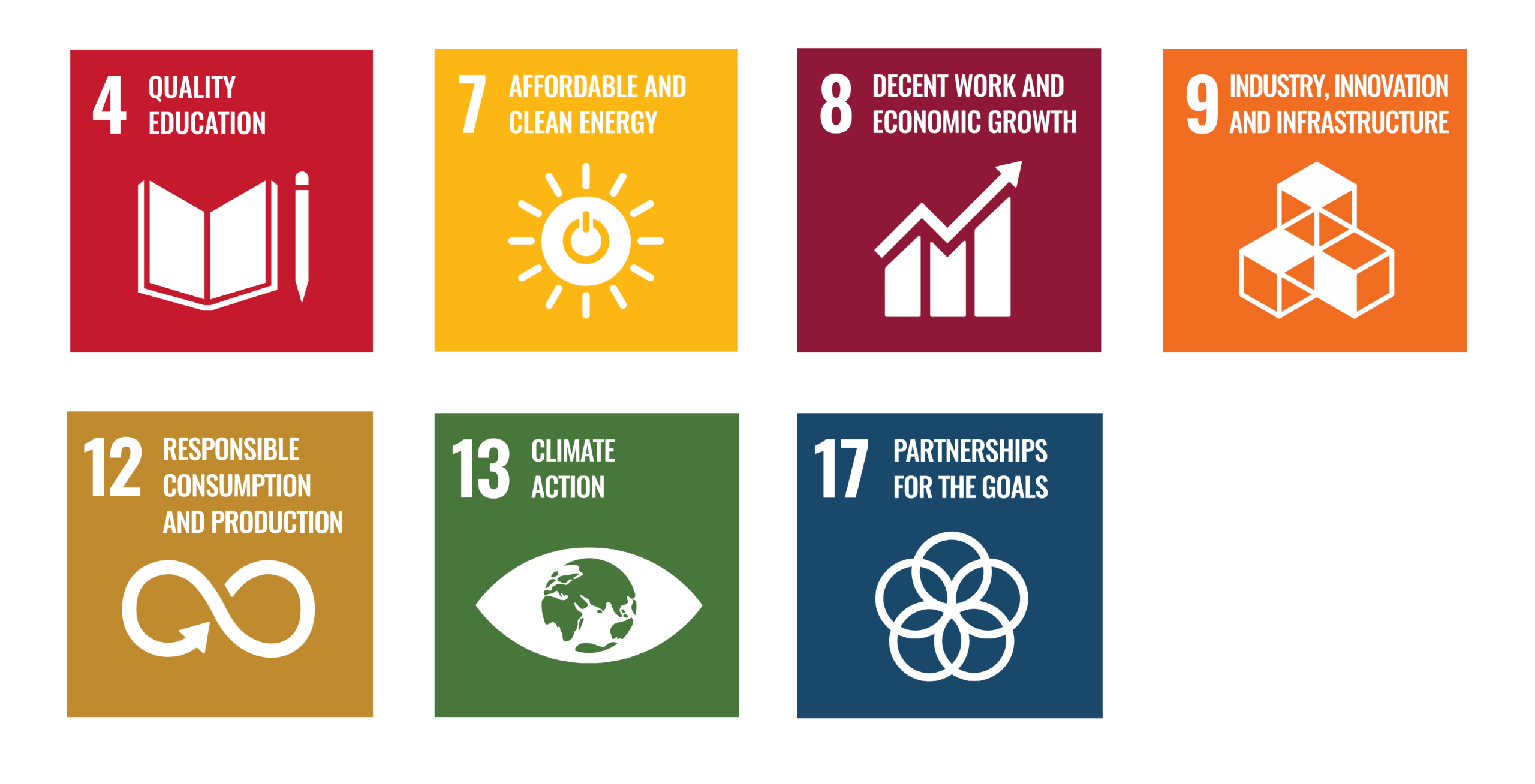
AI research has an energy cost, and it is rapidly growing. An implicit focus of our group’s work is how to use these tools well: building models small enough to train and run without a supercomputer. Another focus is transparency: documenting what our own work costs, so that the figures exist to be compared. Both aims connect our research to the following UN Sustainable Development Goals.
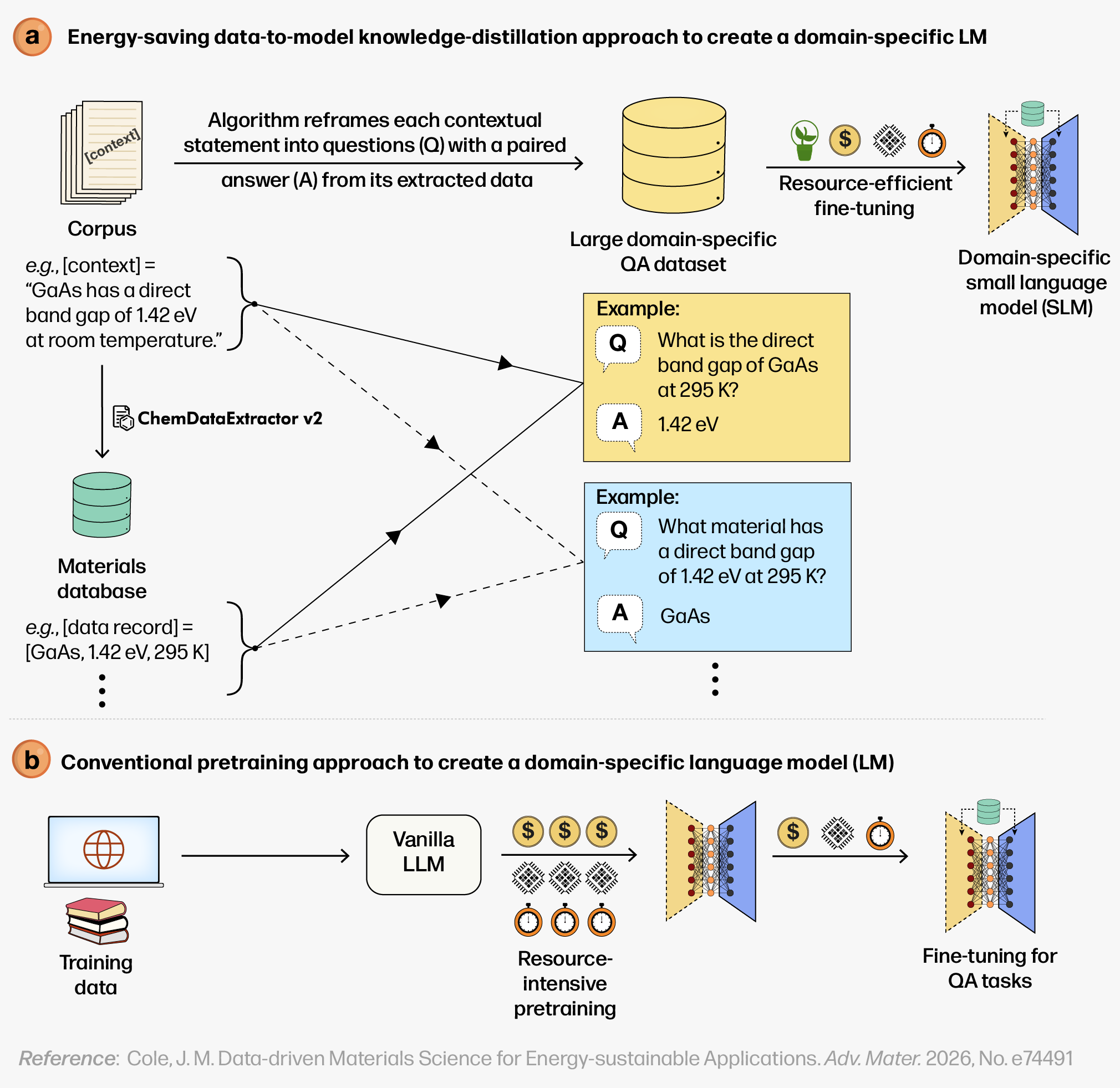
Most energy is consumed during the pretraining stage of training a language model, where it learns the contextual basics of general English language before it learns any vernacular from the scientific domain. Recently, we have found a way to skip that stage. Thereby, we convert a ChemDataExtractor-generated materials database into hundreds of thousands of question–answer (QA) pairs that are then employed to fine-tune a vanilla language model.
In other words, the knowledge is distilled into the model via a QA dataset whose contents are specific to a given materials domain. Performance is comparable to a conventionally trained domain-specific language model, but the energy cost drops sharply. Small, domain-specific models are best suited to extractive tasks such as classification and prompt engineering. Larger language models remain critical for generation or step-by-step reasoning tasks, and that capability justifiably comes at a much higher energy cost.
Pretraining BERT, one of the earliest language models, from scratch emits at least 652 kg of carbon emissions which is roughly three-quarters of a passenger flight from New York to San Francisco [1]. In contrast, our method of fine-tuning a domain-specific model with a large QA dataset costs 1.26 kg.
There is one caveat: published pretraining figures for nearly all language models are lower bounds. They report only the final successful run, not the discarded attempts, hyperparameter searches and ablations behind it, which can multiply the true cost considerably [2]. Our fine-tuning method requires no such exploration, so the figures reported here are close to the full cost [3,4]. The real gap is wider than these numbers suggest.
[1] Strubell, E.; Ganesh, A.; McCallum, A. Energy and Policy Considerations for Modern Deep Learning Research. Proc. Conf. AAAI Artif. Intell. 2020, 34 (09), 13693–13696. https://doi.org/10.1609/aaai.v34i09.7123.
[2] Morrison, J.; Smith, N. A.; Strubell, E. The Hidden Cost of Thinking: Energy Use and Environmental Impact of LMs beyond Pretraining. arXiv [cs.CY], 2026. https://doi.org/10.48550/arXiv.2605.01158.
[3] Zhang, M.; Cole, J. M. Automatic Generation of a Mechanical Properties Question-Answering Data Set for Language Model Benchmarking: A Comparative Study of BERT, XLNet, and LLaMA Models. J. Chem. Inf. Model. 2026, 66 (7), 3840–3857. https://doi.org/10.1021/acs.jcim.5c02646.
[4] Kelly, C. R.; Cole, J. M. Autogenerating a Domain-Specific Question-Answering Data Set to Enable High-Performing Language Models for Magnetic Materials. J. Chem. Inf. Model. 2026, 66 (17), 10896–10918. https://doi.org/10.1021/acs.jcim.6c00136.
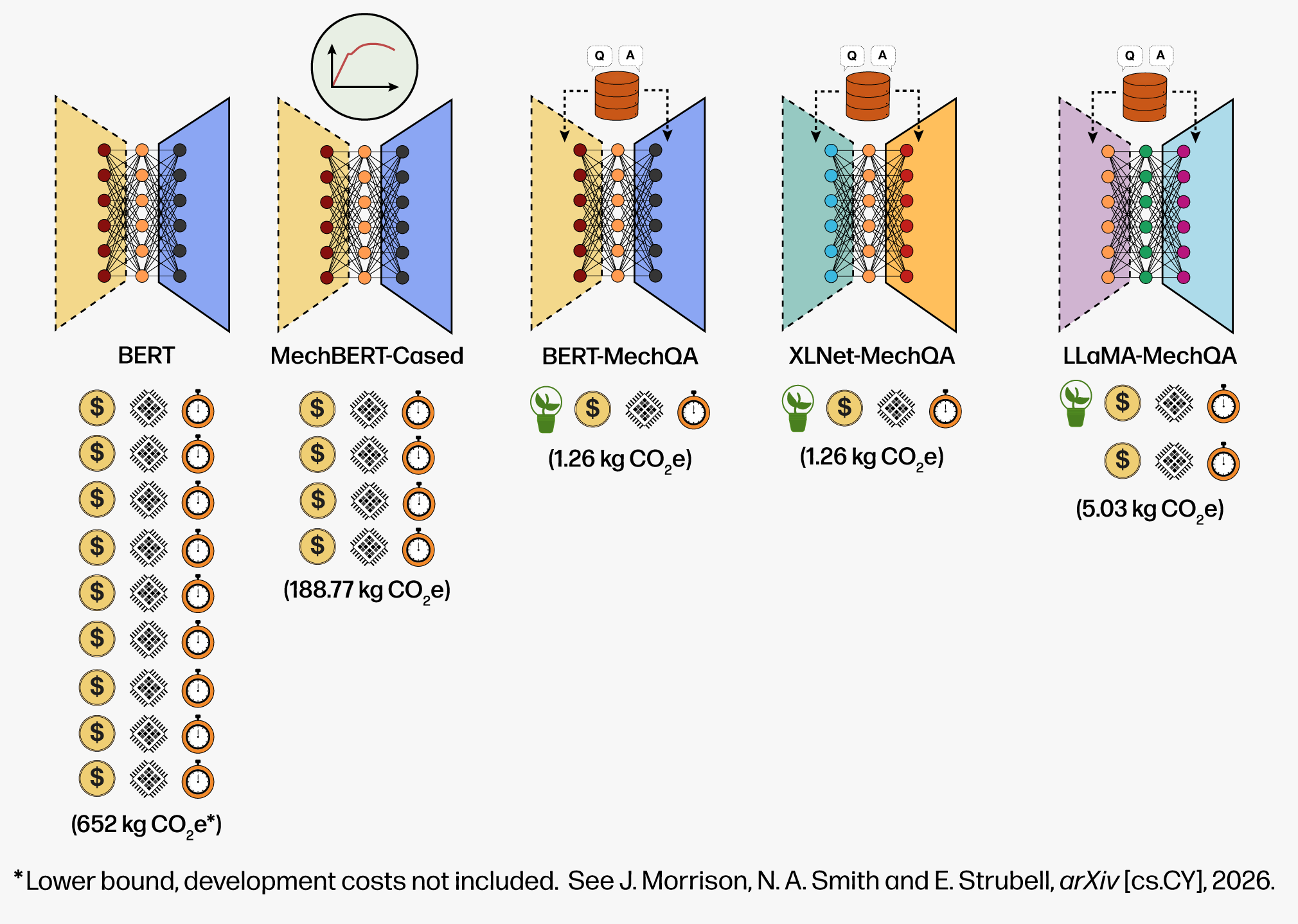
We estimate emissions with the Green Algorithms calculator, using the computing resources reported in each paper and working out unlisted hardware by hand.
Try the Green Algorithms Calculator